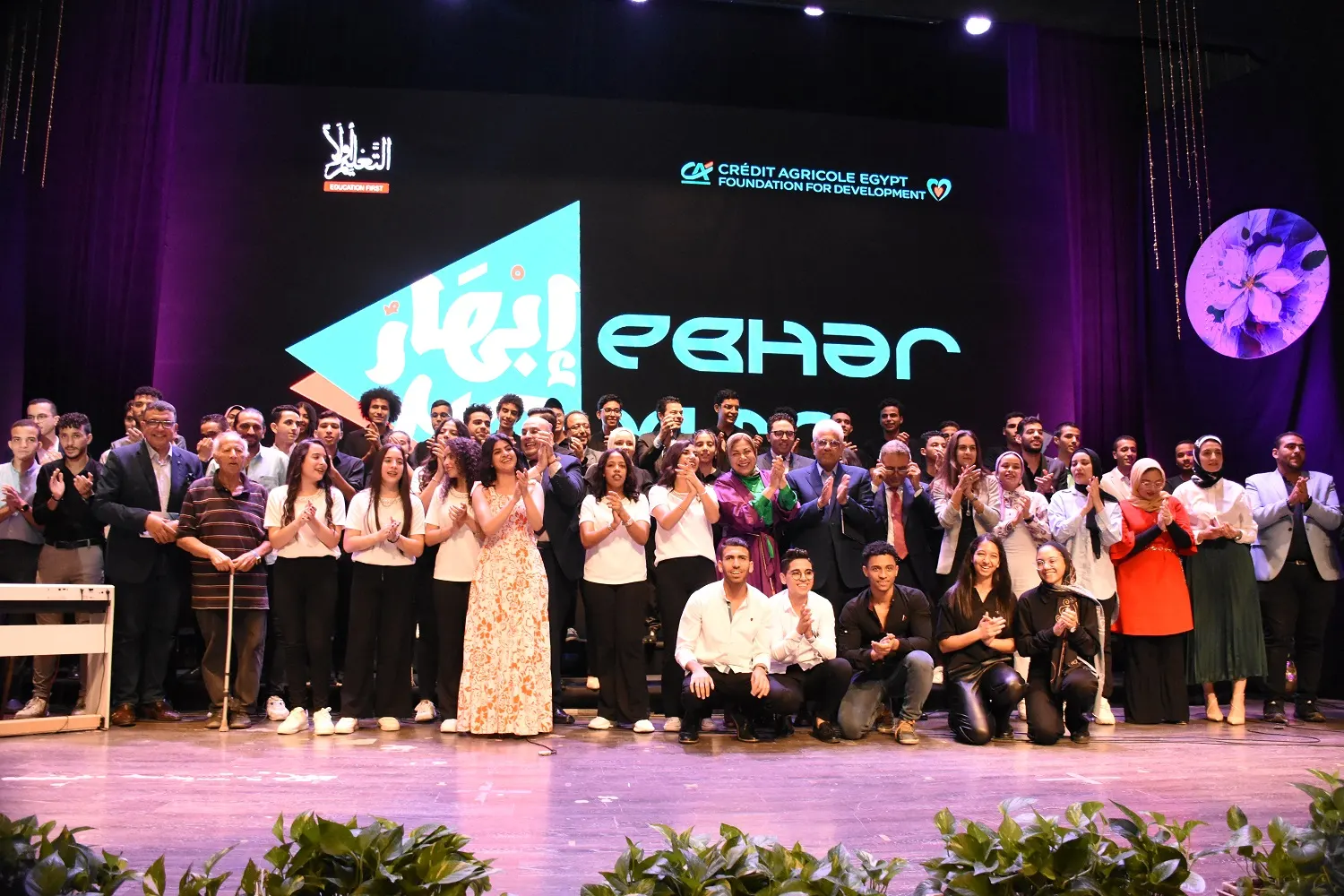
Talented Students Program (Ibhar Misr)
In 2018, the Foundation organized the "Ebharmisr" program, sponsored by Crédit Agricole Development Foundation, to discover and support talented students aged 14 to 18 in science, arts, and technology.
It also includes mathematics and information technology, and contributed to establishing the first online platform in Egypt for discovering talented students.
Ebharmisr is a program for gifted students in Egyptian public schools, sponsored by Crédit Agricole Development Foundation and Education First Foundation, supervised by the Ministry of Education and Ministry of Social Solidarity, and in partnership with Microsoft Egypt, New Generation International Schools, Abami Global, Pompinevich High School in Florida, the Department of Science and Engineering at the American University in Cairo, and EgyCare. Students receive training in specialized skills for their fields, and the scholarship concludes with a science exhibition, an art exhibition, and a musical theater performance.
Training is provided by experts in science, technology, and arts from global academies and institutions.
The program also aims to discover students’ creative potentials and open more pathways for their talents and projects through various institutions and companies.
It is worth noting that the first art exhibition for Ebharmisr students in the field of painting was held in 2020 at the Faculty of Fine Arts in Zamalek and at the Egyptian Opera House.
Over five years, 116 talented students have won the competition across all fields, and a network was established to involve all students in future training courses in their respective fields.
This includes energy and water fields for ages 14 to 18, and 18 to 25 for university students who have not yet graduated. Students submit a preliminary project in the specified fields, and winners receive financial awards in addition to implementing their projects.
Additionally, five annual scholarships are offered to students under a credit-hour system (two in engineering, two in computer science, and one in medicine).
Photo gallery